Dating 4 min read
Historical Codes of Attraction: From Flourishes to Modern Flirting
Discover how historic flirting rituals like beauty marks, fans, and flowers paved the way for the nuanced digital signals used in modern dating today.
A message is marked as read. There is no reply. An hour later, a single heart icon appears. The decoding begins: Is this affection? Mere politeness? A subtle hint?
While this digital uncertainty feels modern, the practice of decoding secret romantic signals long predates smartphones. Before likes, there were beauty marks. Instead of emojis, people used flowers. Long before the read receipt, a folded corner of a calling card carried a hidden message.
Some of these codes were genuine social rituals, while others were clever marketing inventions designed by merchants to drive demand for their goods.
Beauty Marks: The Strategic Spot
In the 18th century, fashion-forward individuals carried tiny black patches made of taffeta or velvet, applied to the face or chest. While some suggest these patches initially served to cover smallpox scars, they quickly became tools of flirtation.
These patches came in various shapes—moons, stars, hearts, and even miniature carriages. However, the true meaning lay not in the shape, but in the placement.
Common interpretations included:
Whether worn by women or men, there was no universal dictionary for these marks. Interpretations varied by source, much like how modern emojis are often open to individual interpretation.
- Near the eye: Passion
- At the temple: A killer, the most daring placement
- Above the lip: Coquetry
- On the cheek: Gallantry
- On the forehead: Grandeur
- On the nose: Boldness
- On the chin: Playfulness
The Language of the Fan: Marketing Myth
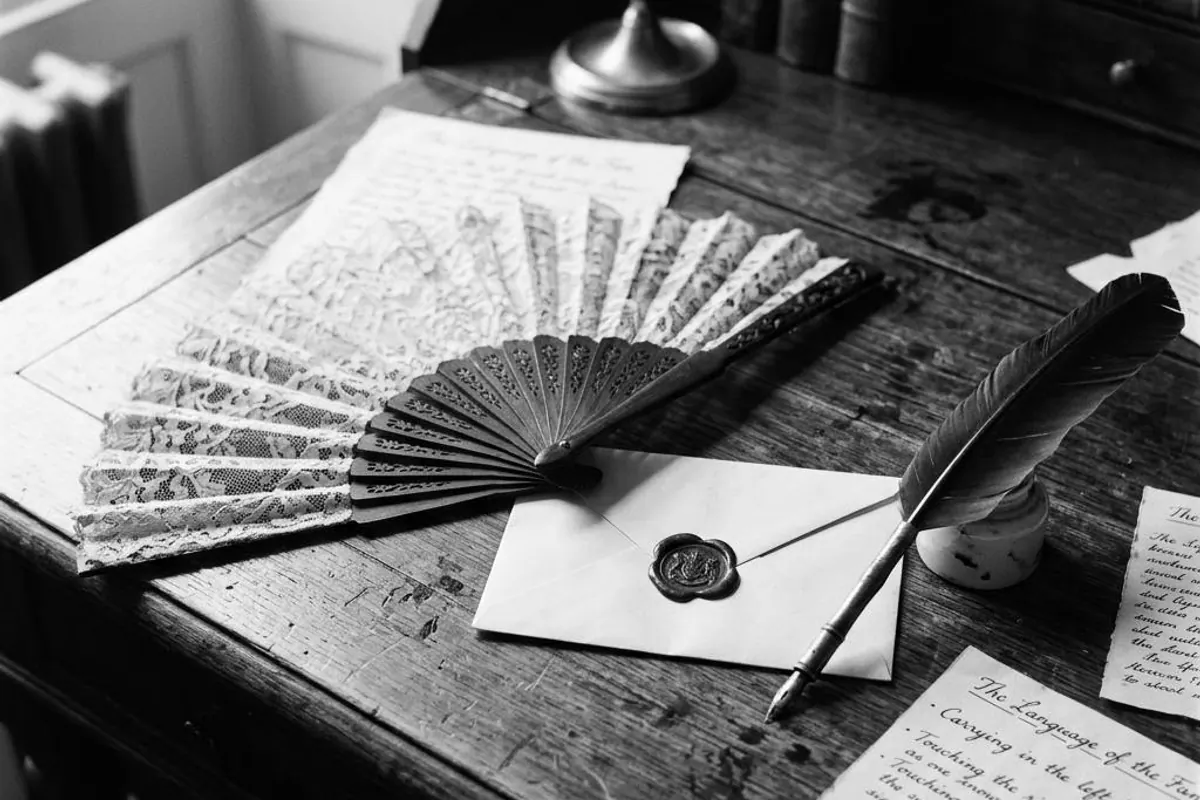
The most famous secret code is arguably the language of the fan; folklore suggests that brushing a fan against one's cheek meant 'I love you.'
While romantic, this code was likely a marketing invention. In the late 19th century, the renowned fan workshop Duvelleroy included pamphlets detailing this language with purchases in London and Paris, suggesting it was an ancient tradition.
The Metropolitan Museum of Art notes that there is no historical evidence for such a systematic code; early mentions of fan signals were largely satirical, and much of the modern mythology was inflated by later publications.
The fan was indeed a tool for flirting—used to mask a smile, hide a yawn, or deflect an unwanted gaze—but it relied on genuine body language rather than a pre-written script.
The Handkerchief: A Silent Signal
A language of the handkerchief once existed, preserved in historical family notebooks. It offered specific signals:
Notably, dropping a handkerchief was intended to signify 'let us be friends,' rather than the romantic confession often attributed to it today.
- Drawing the handkerchief across the cheek: I love you
- Drawing across the forehead: Caution, we are being watched
- Throwing it over the shoulder: Follow me
- Twisting it around the index finger: I am engaged
- Twisting it around the ring finger: I am married
- Placing it on the right cheek: Yes; on the left cheek: No
The Language of Flowers: Bouquet Subtext
In the 19th century, the language of flowers was a popular pastime, allowing a bouquet to express sentiments that were considered improper to state aloud.
Common knowledge included:
Yellow roses were gifted with caution, as flowers could carry meanings unintended by the giver. Due to the lack of a standardized guide, a gift could easily lead to misunderstanding or offense.
- Red rose: Love
- Yellow rose: Fading affection or, in some dictionaries, jealousy
- Yellow carnation: Contempt
- Striped carnation: Refusal
The Calling Card: Etiquette and Intent
Calling cards were an essential element of etiquette. Leaving one when the host was not at home was standard, and a folded corner indicated the card was delivered personally rather than by a servant.
Sometimes the specific fold indicated the purpose of the visit:
For departure, the initials P.P.C. (pour prendre congé, meaning 'to take leave') were written on the card. A card folded in half signified a visit meant for the entire family, allowing the host to instantly identify the guest's intent—a direct precursor to the modern read receipt.
- Bottom right corner: Personal visit
- Top left corner: Congratulations
- Top right corner: Condolences
The Tilted Stamp
With the arrival of postcards, privacy became a concern, as messages could be read by anyone from postal workers to family members.
A workaround was soon found: the angle of the postage stamp. By placing the stamp at different tilts, the sender could convey a hidden message. Because there were many competing 'keys' to this language, both the sender and receiver had to agree on the same version for the message to be understood.
The Evolution of Connection
Every era has crafted its own symbols to convey deep meaning without words. While some were marketing gimmicks, people have always found joy in the game of subtle communication, as a hint often creates more intrigue than a direct statement.
Today, the beauty mark is replaced by a heart icon, the bouquet by a sticker, and the folded card by digital notifications. The tools of our interactions have evolved, but the fundamental human desire to understand the feelings of another remains unchanged.